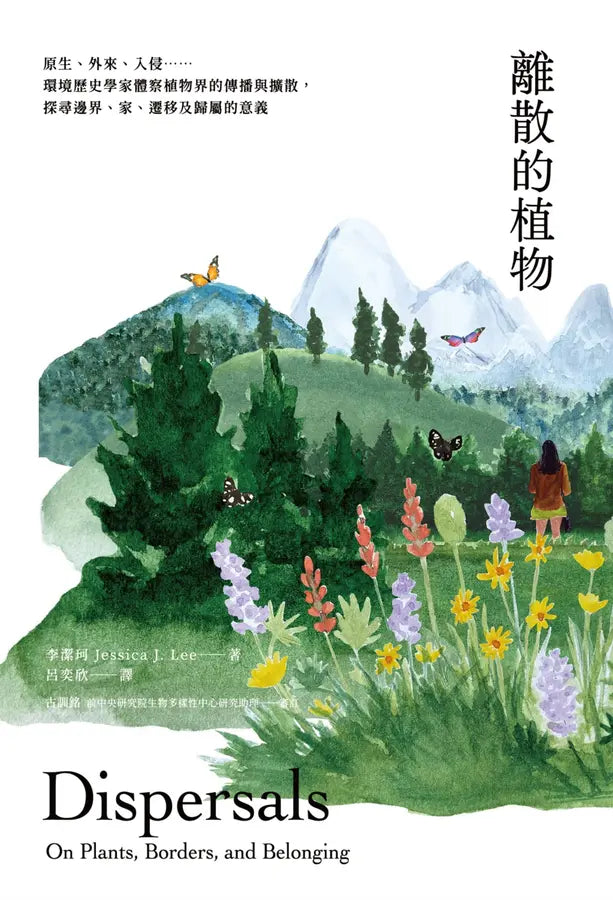
Discrete plants
Discrete plants
Couldn't load pickup availability
Native, foreign, intrusive...
Environmental historians study the spread and diffusion of the plant kingdom.
Exploring the meaning of boundaries, home, migration, and belonging
People often think of plants as static, and the word "rooted" is used not only to describe plants, but also sometimes to describe people who belong to a certain place. However, plants may accidentally leave their native habitat and drift across the ocean with ballast water; or they may be deliberately collected by collectors who travel to foreign lands to improve the agricultural production of their home countries; or, in a globalized world, immigrants who leave their homes take plants with them, thus carrying a small part of their original homeland with them to other places.
Li Jieke, the author of this book, possesses a Canadian citizenship and is of mixed Taiwanese and British descent, giving her a particularly keen sensitivity to concepts such as "migration," "exile," "native," and "foreign." During the writing of *Dispersed Plants*, she was unexpectedly forced to relocate between two countries, three cities, and four different residences. Her personal experiences, coupled with her formal training in environmental history and landscape aesthetics, have enabled her to keenly observe the landscapes reflected in the natural environment by the human world, and she is also accustomed to reflecting on the interaction between human-constructed societies and the wild environment.
In this book, she explores the history of the "migration" of tea, which was brought to another continent for commercial cultivation by imperial explorers; she also investigates why soybeans, a common food on East Asian tables, have always been relegated to a secondary position in cultural imagery and daily diet after being introduced to North America. In addition, invasive algae in ponds, mosses that spread as far as the Arctic Circle, and weeds that everyone wants to get rid of... all prompt the author to ask: What happens when these plants leave their native home and take root elsewhere?
This book blends memoir, history, and natural science to explore the entanglement between the plant and human worlds, and the author also finds parallels and points of comparison in the migrations of plants and humans. The plants examined in the fourteen articles throughout the book are, to some extent, considered "out of place," and through them, readers can think about the true meaning of "home," "belonging," and "inclusion" from a new perspective.
Highly recommended
After reading this book, readers will have Li Jieke's voice lingering in their minds for a long time.
--Starred rating from Library Journal
The author interweaves personal history with a subtle optimism. Like plants that have left their homeland and been replanted in a new environment, we too adapt to transition, migration, and remembrance. This book is a profound reflection on nature and identity in a constantly changing world.
—Kirkus Review
Li Jieke vividly describes her encounters with various plant species and raises reflective questions about plants and her own sense of belonging. Readers interested in plant and environmental studies will particularly find the book's analogies to human society in its depictions of life's turning points and changes thought-provoking.
—Booklist
Among contemporary writers who depict nature, identity, and place, she is one of the most interesting and well-known authors... Li Jieke's works skillfully intertwine personal memoirs and family histories with botany, cultural criticism, and firsthand observations of the natural world.
—The Berliner
Li Jieke invokes the centuries-long history of humans and plants crossing borders, from which she questions the true meaning of "belonging," "love," and "protection," and what our shared future will look like on this planet with its constant intercontinental migrations.
--Literary Hub website
Li Jieke's lyrical prose grows from the fertile soil of thorough research and intimately connected personal memories. These memories are sometimes vivid and lively, sometimes shrouded in a gentle mist as the years pass... From seaweed to soybeans, to citrus fruits... her writing seamlessly connects these themes. Li Jieke makes you stop and smell the scent of weeds.
—The Cut
About the Author
Jessica J. Lee / Author
A Canadian writer and environmental historian of Taiwanese and British descent. He has received the Hilary Weston Writers' Trust Prize for Nonfiction, the Boardman Tasker Award for Mountain Literature, the Banff Mountain Book Award, and the RBC Taylor Prize Emerging Writer Award.
Translated by Lü Yixin
A graduate of the Translation Department at National Taiwan Normal University, she previously worked in publishing and finance, and now specializes in translation.
分享